
ISO 9001 Certification in Australia – Everything you need to know

ISO 9001 Certification in Australia

ISO 9001 certification is becoming increasingly essential for Australian life sciences organisations seeking to compete globally, attract investment, and demonstrate operational excellence. From Sydney’s thriving medtech hub to Melbourne’s pharmaceutical research centres, and emerging biotech clusters across Brisbane, Perth, and Adelaide, Australian organisations are recognising ISO 9001 as a strategic differentiator. 

This comprehensive guide covers everything Australian research labs, biotech startups, pharmaceutical companies, medical device distributors and clinical research organisations need to know about achieving ISO 9001 certification, including local certification bodies, timelines, costs, and success strategies. 

ISO 9001 in the Australian Context
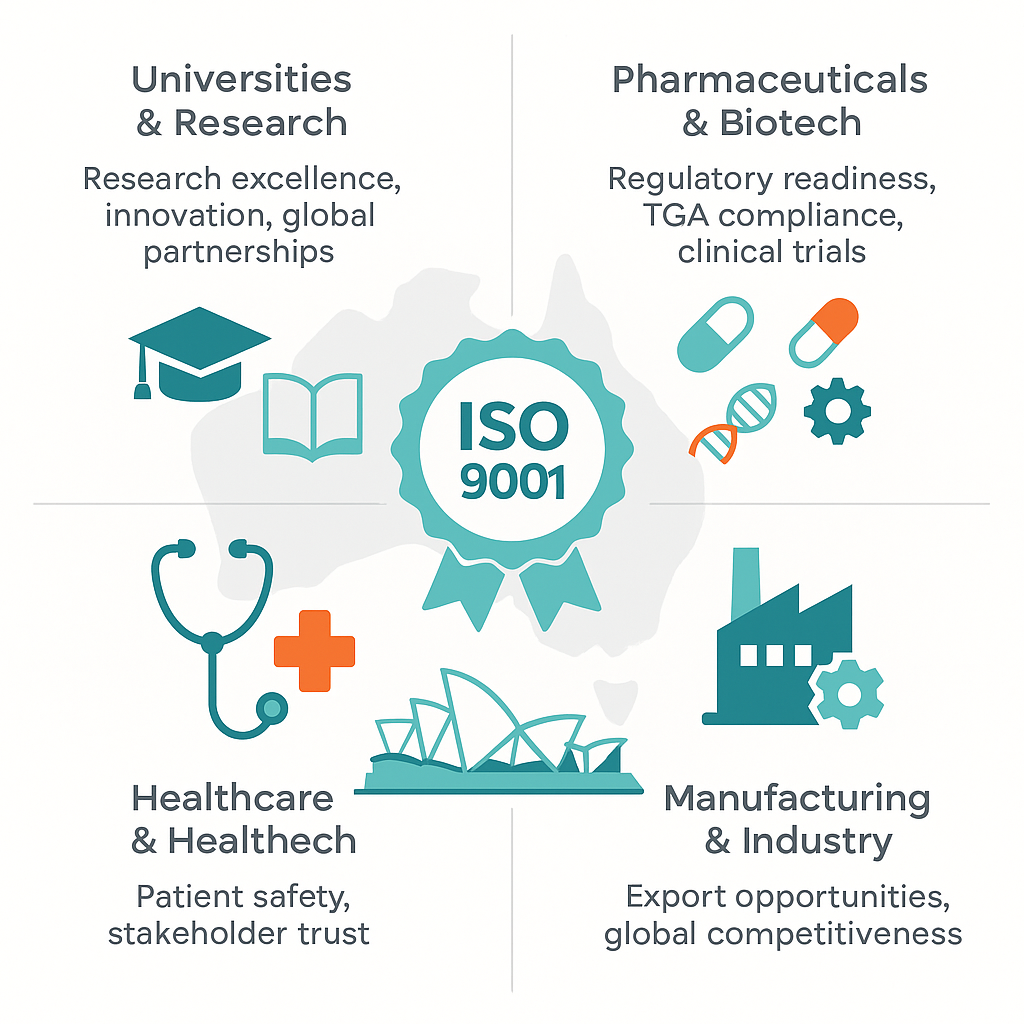
ISO 9001 Certification in Australia

The demand for ISO 9001 certification is growing rapidly across Australian research organisations, biotech startups, pharmaceutical companies, and healthtech enterprises.  

Australia’s life sciences sector is experiencing unprecedented growth, driven by government initiatives like the Medical Research Future Fund (MRFF), increased venture capital investment, and expanding international collaborations. ISO 9001 certification provides the quality foundation that enables Australian organisations to: 

  • Compete effectively in global markets 
  • Meet international partnership requirements 
  • Attract venture capital and institutional investment 
  • Demonstrate regulatory readiness to the TGA and international bodies 
  • Access export opportunities and overseas clinical trial networks 

Certification is delivered by accredited certification bodies operating in Australia, including SAI Global, BSI Group, Intertek, and Lloyd’s Register, ensuring organisations receive internationally recognised certification under the Joint Accreditation System of Australia and New Zealand (JAS-ANZ) framework. 

Benefits of ISO 9001 Certification in Australia

  • Builds trust with investors and collaborators by demonstrating commitment to world-class quality management systems that meet international standards expected by global partners.  

  • Demonstrates compliance readiness for TGA regulations, export requirements, and international regulatory frameworks, positioning Australian organisations for seamless market entry across multiple jurisdictions. 

  • Creates competitive advantage in securing government grants, research funding, and commercial partnerships, with many funding bodies and collaborators now expecting quality certification as evidence of operational maturity. 

  • Drives operational efficiency through systematic process improvements, risk management, and performance monitoring that reduce costs, minimise errors, and accelerate time-to-market for Australian innovations. 

  • Facilitates international expansion by providing globally recognised quality credentials that open doors to overseas markets, clinical trial opportunities, and strategic partnerships. 

The ISO 9001 Certification Process in Australia

Step 1: Select a Certification Body 

Choose from established Australian certification providers including SAI Global, BSI Group, Intertek, Lloyd’s Register, or other JAS-ANZ accredited bodies. Consider factors such as industry expertise, local presence, and cost structures when making your selection.  

Step 2: Conduct Gap Assessment 

Evaluate current quality practices against ISO 9001 requirements, considering Australian regulatory context, industry-specific requirements, and organisational readiness. This assessment forms the foundation for your implementation roadmap.  

Step 3: Develop Documentation 

Create quality management system documentation including Quality Manual, Standard Operating Procedures, risk management frameworks, and record-keeping systems aligned with both ISO 9001 requirements and Australian regulatory expectations.  

Step 4: Implement System & Train Personnel 

Roll out QMS processes across the organisation while ensuring all staff receive appropriate training on their roles within the QMS. Focus on building quality culture alongside system compliance. 

Step 5: Process Implementation and Improvement 

Implement your processes and make incremental improvements as needed by formalising changes following change management procedures, documenting and managing non-conformances systematically, capturing customer complaints and feedback, and updating procedures to ensure alignment with current practices. 

Step 6: Management Review 

Conduct regular management reviews to evaluate QMS effectiveness and ensure continual improvement by assessing progress against quality objectives and performance indicators, reviewing findings from internal and external audits, considering customer, collaborator, and stakeholder feedback, evaluating nonconformities and corrective actions, monitoring risks and opportunities affecting scientific and business priorities, and confirming adequacy of resources including staff, training, and infrastructure. 

Step 7: Certification Audit 

Work with your chosen certification body through Stage 1 (documentation review and readiness assessment) and Stage 2 (full certification audit) to achieve ISO 9001 certification. 

How Long Does ISO 9001 Certification Take in Australia?

Implementation typically requires 6-12 months for most Australian life sciences organisations, though timelines vary based on several key factors: 

Organisational factors influencing timeline: 
  • Company size and operational complexity 
  • Existing quality systems and documentation maturity 
  • Resource allocation and management commitment 
  • Staff availability for training and implementation activities 
Industry-specific considerations: 
  • Startups and early-stage research organisations may require additional time as they often need to establish governance frameworks, business policies, and documented processes establishing core systems first. typically implement more quickly than established organisations with legacy processes 
  • Established organisations with legacy systems may face delays in aligning existing processes with ISO 9001 requirements, as older practices often require significant change management. 
  • Organisations already operating under recognised frameworks (e.g., TGA GMP licensed facilities, OECD GLP, ISO 13485) can often progress faster, as they can leverage existing documentation, compliance structures, and quality culture. So, ISO 9001 is more of a structed add-on. 

For example, a biotech startup with no formal policies may take 12–18 months to implement ISO 9001, while a TGA GMP-licensed pharmaceutical facility may achieve certification in under a year by building on established quality systems. 

External factors: 
  • Certification body scheduling and availability can significantly affect timelines, as auditor availability and scheduling constraints may cause delays when an organisation is ready. For example, Phage Australia experienced multiple scheduling delays with their certification body, which extended their certification time. 
  • Consultant support and expertise level plays a key role in implementation. Skilled consultants streamline documentation, reduce nonconformities, and accelerate certification, while limited support may slow down progress. Organisations with dedicated external guidance, such as SmartQMS, typically progress more quickly than those relying solely on internal teams.  
  • Integration requirements with other standards or regulatory frameworks often add complexity. Organisations aiming to align ISO 9001 with existing frameworks such as TGA-GMP, OECD GLP, or ISO 17025 may require additional time to harmonise documentation and ensure consistency across systems, particularly when technical procedures and quality requirements need to be cross-mapped. 

ISO 9001 Costs in Australia

Understanding the investment required for ISO 9001 certification helps Australian organisations budget effectively and evaluate return on investment. 

  • Certification body fees include initial audit (Stage 1 and Stage 2) costs, annual surveillance audits, and three-yearly recertification audits. In Australia, these costs typical range from AUD $4,000–$15,000 per year, depending on organisation size, complexity, and certification provider. 
  • Internal resource allocation represents the largest cost component, including staff time for documentation development, system implementation, training participation, and ongoing quality management activities. 
  • Professional consultant support can significantly accelerate implementation and reduce internal resource burden. While representing additional upfront investment, experienced consultants often deliver strong ROI through faster implementation, reduced non-conformances, and more effective system design. 
  • Long-term value considerations include improved operational efficiency, reduced error rates, enhanced market access, and increased investment attractiveness that typically justify initial certification investments. 

SmartQMS – Your Partner for ISO 9001 Certification

SmartQMS specialises in ISO 9001 implementation for life science organisations across Australia and beyond.

Our consultants have helped research institutes, biotech startups, and medtech manufacturers design fit-for-purpose quality systems that enhance innovation, reproducibility, and regulatory compliance.

We typically work with companies on long-term contract, providing fractional Quality-as-service, where we become your Quality department for a period of time, providing you end-to-end solution from QMS development all the way to ISO certification 

Proven Australian Success Stories 

SmartQMS has successfully guided Australian life sciences organisations to ISO 9001 certification, including Phage Australia, RNA Institute, and UNSW Recombinant Product Facility.  


📌  Contact Us to start your ISO 9001 journey today

FAQs About ISO 9001 in Australia

  • Which industries need ISO 9001 certification in Australia? 

ISO 9001 provides value across all Australian life sciences sectors including biotechnology, pharmaceuticals, medical technology, clinical research, healthtech, and academic research institutions. Manufacturing, consulting, and service organisations also benefit significantly from certification. 

  • Who provides ISO 9001 certification in Australia?

Certification is delivered by JAS-ANZ accredited bodies including SAI Global, BSI Group, Intertek, Lloyd’s Register, and other recognised providers. Choose certification bodies with relevant industry experience and strong local presence.  

  • How often is re-certification required? 

ISO 9001 certificates are valid for three years, with annual surveillance audits typically required to maintain certification. Recertification audits occur every three years to renew the certificate for another three-year period. 

  • What are common pitfalls in certification? 

Typical challenges include resource allocation during busy periods, integrating quality requirements with fast-paced innovation environments, cultural change management, and balancing compliance with operational efficiency. Professional guidance helps navigate these challenges effectively. 

References

  1. ISO – International Organization for Standardization. ISO 9001:2015 Quality Management Systems – Requirements. https://www.iso.org/standard/62085.html  
  2. JAS-ANZ. Accredited Certification Bodies in Australia and New Zealand. https://www.jas-anz.org  
  3. Standards Australia. ISO 9001 Certification Guidance. https://www.standards.org.au  
  4. Therapeutic Goods Administration (TGA). Good Manufacturing Practice (GMP) for Medicines and Biologicals. https://www.tga.gov.au  
  5. Australian Government, Department of Health. Medical Research Future Fund (MRFF). https://www.health.gov.au 

ISO 9001 Certification in Australia – Everything you need to know

ISO 9001 Certification in Australia

ISO 9001 certification is becoming increasingly essential for Australian life sciences organisations seeking to compete globally, attract investment, and demonstrate operational excellence. From Sydney’s thriving medtech hub to Melbourne’s pharmaceutical research centres, and emerging biotech clusters across Brisbane, Perth, and Adelaide, Australian organisations are recognising ISO 9001 as a strategic differentiator. 

This comprehensive guide covers everything Australian research labs, biotech startups, pharmaceutical companies, medical device distributors and clinical research organisations need to know about achieving ISO 9001 certification, including local certification bodies, timelines, costs, and success strategies. 

ISO 9001 in the Australian Context

ISO 9001 Certification in Australia

The demand for ISO 9001 certification is growing rapidly across Australian research organisations, biotech startups, pharmaceutical companies, and healthtech enterprises.  

Australia’s life sciences sector is experiencing unprecedented growth, driven by government initiatives like the Medical Research Future Fund (MRFF), increased venture capital investment, and expanding international collaborations. ISO 9001 certification provides the quality foundation that enables Australian organisations to: 

  • Compete effectively in global markets 
  • Meet international partnership requirements 
  • Attract venture capital and institutional investment 
  • Demonstrate regulatory readiness to the TGA and international bodies 
  • Access export opportunities and overseas clinical trial networks 

Certification is delivered by accredited certification bodies operating in Australia, including SAI Global, BSI Group, Intertek, and Lloyd’s Register, ensuring organisations receive internationally recognised certification under the Joint Accreditation System of Australia and New Zealand (JAS-ANZ) framework. 

Benefits of ISO 9001 Certification in Australia

  • Builds trust with investors and collaborators by demonstrating commitment to world-class quality management systems that meet international standards expected by global partners.  

  • Demonstrates compliance readiness for TGA regulations, export requirements, and international regulatory frameworks, positioning Australian organisations for seamless market entry across multiple jurisdictions. 

  • Creates competitive advantage in securing government grants, research funding, and commercial partnerships, with many funding bodies and collaborators now expecting quality certification as evidence of operational maturity. 

  • Drives operational efficiency through systematic process improvements, risk management, and performance monitoring that reduce costs, minimise errors, and accelerate time-to-market for Australian innovations. 

  • Facilitates international expansion by providing globally recognised quality credentials that open doors to overseas markets, clinical trial opportunities, and strategic partnerships. 

The ISO 9001 Certification Process in Australia

Step 1: Select a Certification Body 

Choose from established Australian certification providers including SAI Global, BSI Group, Intertek, Lloyd’s Register, or other JAS-ANZ accredited bodies. Consider factors such as industry expertise, local presence, and cost structures when making your selection.  

Step 2: Conduct Gap Assessment 

Evaluate current quality practices against ISO 9001 requirements, considering Australian regulatory context, industry-specific requirements, and organisational readiness. This assessment forms the foundation for your implementation roadmap.  

Step 3: Develop Documentation 

Create quality management system documentation including Quality Manual, Standard Operating Procedures, risk management frameworks, and record-keeping systems aligned with both ISO 9001 requirements and Australian regulatory expectations.  

Step 4: Implement System & Train Personnel 

Roll out QMS processes across the organisation while ensuring all staff receive appropriate training on their roles within the QMS. Focus on building quality culture alongside system compliance. 

Step 5: Process Implementation and Improvement 

Implement your processes and make incremental improvements as needed by formalising changes following change management procedures, documenting and managing non-conformances systematically, capturing customer complaints and feedback, and updating procedures to ensure alignment with current practices. 

Step 6: Management Review 

Conduct regular management reviews to evaluate QMS effectiveness and ensure continual improvement by assessing progress against quality objectives and performance indicators, reviewing findings from internal and external audits, considering customer, collaborator, and stakeholder feedback, evaluating nonconformities and corrective actions, monitoring risks and opportunities affecting scientific and business priorities, and confirming adequacy of resources including staff, training, and infrastructure. 

Step 7: Certification Audit 

Work with your chosen certification body through Stage 1 (documentation review and readiness assessment) and Stage 2 (full certification audit) to achieve ISO 9001 certification. 

How Long Does ISO 9001 Certification Take in Australia?

Implementation typically requires 6-12 months for most Australian life sciences organisations, though timelines vary based on several key factors: 

Organisational factors influencing timeline: 
  • Company size and operational complexity 
  • Existing quality systems and documentation maturity 
  • Resource allocation and management commitment 
  • Staff availability for training and implementation activities 
Industry-specific considerations: 
  • Startups and early-stage research organisations may require additional time as they often need to establish governance frameworks, business policies, and documented processes establishing core systems first. typically implement more quickly than established organisations with legacy processes 
  • Established organisations with legacy systems may face delays in aligning existing processes with ISO 9001 requirements, as older practices often require significant change management. 
  • Organisations already operating under recognised frameworks (e.g., TGA GMP licensed facilities, OECD GLP, ISO 13485) can often progress faster, as they can leverage existing documentation, compliance structures, and quality culture. So, ISO 9001 is more of a structed add-on. 

For example, a biotech startup with no formal policies may take 12–18 months to implement ISO 9001, while a TGA GMP-licensed pharmaceutical facility may achieve certification in under a year by building on established quality systems. 

External factors: 
  • Certification body scheduling and availability can significantly affect timelines, as auditor availability and scheduling constraints may cause delays when an organisation is ready. For example, Phage Australia experienced multiple scheduling delays with their certification body, which extended their certification time. 
  • Consultant support and expertise level plays a key role in implementation. Skilled consultants streamline documentation, reduce nonconformities, and accelerate certification, while limited support may slow down progress. Organisations with dedicated external guidance, such as SmartQMS, typically progress more quickly than those relying solely on internal teams.  
  • Integration requirements with other standards or regulatory frameworks often add complexity. Organisations aiming to align ISO 9001 with existing frameworks such as TGA-GMP, OECD GLP, or ISO 17025 may require additional time to harmonise documentation and ensure consistency across systems, particularly when technical procedures and quality requirements need to be cross-mapped. 

ISO 9001 Costs in Australia

Understanding the investment required for ISO 9001 certification helps Australian organisations budget effectively and evaluate return on investment. 

  • Certification body fees include initial audit (Stage 1 and Stage 2) costs, annual surveillance audits, and three-yearly recertification audits. In Australia, these costs typical range from AUD $4,000–$15,000 per year, depending on organisation size, complexity, and certification provider. 
  • Internal resource allocation represents the largest cost component, including staff time for documentation development, system implementation, training participation, and ongoing quality management activities. 
  • Professional consultant support can significantly accelerate implementation and reduce internal resource burden. While representing additional upfront investment, experienced consultants often deliver strong ROI through faster implementation, reduced non-conformances, and more effective system design. 
  • Long-term value considerations include improved operational efficiency, reduced error rates, enhanced market access, and increased investment attractiveness that typically justify initial certification investments. 

SmartQMS – Your Partner for ISO 9001 Certification

SmartQMS specialises in ISO 9001 implementation for life science organisations across Australia and beyond.

Our consultants have helped research institutes, biotech startups, and medtech manufacturers design fit-for-purpose quality systems that enhance innovation, reproducibility, and regulatory compliance.

We typically work with companies on long-term contract, providing fractional Quality-as-service, where we become your Quality department for a period of time, providing you end-to-end solution from QMS development all the way to ISO certification 

Proven Australian Success Stories 

SmartQMS has successfully guided Australian life sciences organisations to ISO 9001 certification, including Phage Australia, RNA Institute, and UNSW Recombinant Product Facility.  


📌  Contact Us to start your ISO 9001 journey today

FAQs About ISO 9001 in Australia

  • Which industries need ISO 9001 certification in Australia? 

ISO 9001 provides value across all Australian life sciences sectors including biotechnology, pharmaceuticals, medical technology, clinical research, healthtech, and academic research institutions. Manufacturing, consulting, and service organisations also benefit significantly from certification. 

  • Who provides ISO 9001 certification in Australia?

Certification is delivered by JAS-ANZ accredited bodies including SAI Global, BSI Group, Intertek, Lloyd’s Register, and other recognised providers. Choose certification bodies with relevant industry experience and strong local presence.  

  • How often is re-certification required? 

ISO 9001 certificates are valid for three years, with annual surveillance audits typically required to maintain certification. Recertification audits occur every three years to renew the certificate for another three-year period. 

  • What are common pitfalls in certification? 

Typical challenges include resource allocation during busy periods, integrating quality requirements with fast-paced innovation environments, cultural change management, and balancing compliance with operational efficiency. Professional guidance helps navigate these challenges effectively. 

References

  1. ISO – International Organization for Standardization. ISO 9001:2015 Quality Management Systems – Requirements. https://www.iso.org/standard/62085.html  
  2. JAS-ANZ. Accredited Certification Bodies in Australia and New Zealand. https://www.jas-anz.org  
  3. Standards Australia. ISO 9001 Certification Guidance. https://www.standards.org.au  
  4. Therapeutic Goods Administration (TGA). Good Manufacturing Practice (GMP) for Medicines and Biologicals. https://www.tga.gov.au  
  5. Australian Government, Department of Health. Medical Research Future Fund (MRFF). https://www.health.gov.au 

Featured Articles

Featured video

Watch Dr. Paul Harris talk about family health care practice and his patient-centered approach

Healthy Newsletter

Quo ea etiam viris soluta, cum in aliquid oportere. Eam id omnes alterum. Mei velit
ISO 9001 Certification in Australia